
To Seal or Not to Seal? Chest Seals for the Outdoor Adventurer’s Kit
Beyond The Basics: Selecting the Right Medical Kit For Your Outdoor Adventures
You think you’ve got your first aid kit sorted with tourniquets, haemostats, plasters, maybe even in a nice pouch. But now someone mentions chest seals, and you’re wondering, do I really need one of those in my outdoor medical kit?
If you’re a hiker on well trodden paths, maybe not. But if you’re on expedition, riding enduro through forests, ice climbing, or operating sharp tools in remote places, then the answer is likely yes.
Here’s what you need to know, and what’s worth buying.
UK Practice and Chest Seal Recalls – What You Need to Know
In UK prehospital and outdoor medicine, chest seals have become a standard part of advanced trauma kits, especially in wilderness, tactical, and high risk remote work environments. But that doesn’t mean any seal will do.
What Is a Chest Seal?
A chest seal is a trauma dressing designed to cover and hopefully treat open chest wounds, especially ones that could lead to a sucking chest wound or tension pneumothorax. This is a life threatening conditions where air enters the chest cavity through a wound but can’t escape. The pressure can build and cause compression on lungs or the heart. A chest seal hopes stop this from getting worse and potentially restore pressure balance.
Vented Vs. Non-Vented – What’s the Difference?
Vented chest seals (usually with one way valves or perforated channels) let air and fluids escape while preventing external air or fluid from entering.
Non-vented chest seals completely seal the wound. They’re simple, often stickier, and work well when you’re unsure of the injury’s complexity.
Common Brands & Options Compared
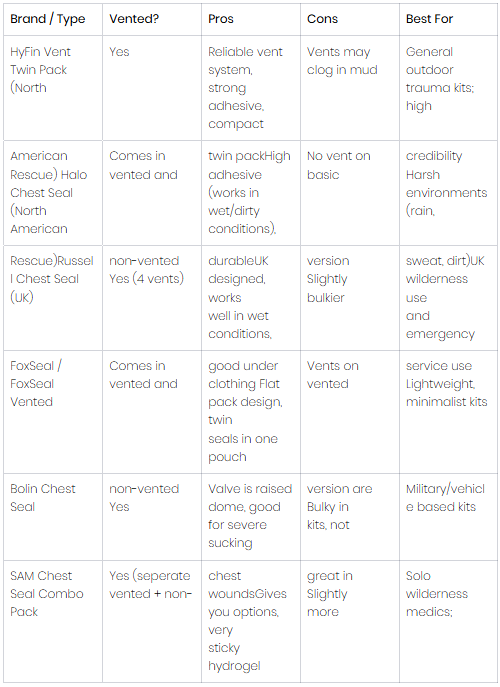
Improvised Chest Seals
Caught out? You can improvise with:
Cling film or sandwich bag and tape
Plastic packaging from other medical kit like bandage
Foil or crisp packets
Carrier bags
All roughly credit card size, or similar
Improved 3 sided dressings for venting is a fairly “old school” method and not taught or recommended anymore as fully acclusive is now preferred
Do Vented Chest Seals Actually Work? And What Does UK Guidance Say?
When it comes to managing open chest wounds in prehospital and outdoor settings, chest seals are a crucial part of trauma care kits. But one question keeps coming up:
Do vented chest seals actually work, and should you choose vented or unvented?
As discussed above, vented chest seals are designed with one way valves or multiple vent channels. These allow air and pressure to escape from the pleural space during exhalation, while preventing air from entering the chest cavity on inhalation, helping to reduce the risk of tension pneumothorax.
In theory, they offer the best of both worlds:
Occlusion of the open wound
Pressure relief without needing to “burp” the seal manually
Studies and real world experience suggest that vented seals can be effective, particularly when:
The vents remain unobstructed by blood, clothing, or debris
The seal adheres well in challenging environments (wet, sweaty, hairy skin). However, in some cases the pressure isn’t enough to open the values to push air out. Also, especially in outdoor or hostile environments, vents can clog or seals may lose adhesion. This has led to ongoing discussion in trauma care circles.
UK Prehospital Guidance: Vented or Unvented?
As of the latest UK prehospital care guidelines (including JRCALC and military trauma guidance), the preferred first line choice for open chest wounds is a vented chest seal, when available and practical.
Why vented? To reduce the likelihood of tension pneumothorax without the need to lift or remove the seal, particularly important in remote or prolonged prehospital care.
When to use unvented: If a vented seal is not available, or if the vent is suspected to be blocked or ineffective, an unvented seal can be used, but must be closely monitored for signs of developing tension (increased respiratory distress, worsening hypoxia, etc.). In such cases, burping or temporarily lifting the seal may be necessary.
Factors It Would Be Silly to Ignore
While vented chest seals are often promoted as the gold standard for treating open pneumothorax, there are some practical realities that shouldn't be overlooked, especially in outdoor, remote, or resource-limited settings.
Storage & Portability
Vented seals often include rigid components (like valves or channel systems), making them difficult to fold or pack without risking damage. This can be a real issue for responders working with limited pack space or needing to carry lightweight kits over long distances.
On the other hand, unvented chest seals are essentially large adhesive occlusive dressings. They're flat, flexible, and easy to store, even in small kits or minimalist trauma kits, making them a more convenient option for many outdoor responders.
Cost Considerations
Vented chest seals are also not cheap, often double or more the price of a basic unvented option. For teams or individuals stocking multiple kits (e.g. event medics, mountain rescue, expedition leaders), cost adds up fast.
If your choice is between a high end vented seal you can’t afford to carry, and a basic unvented seal that fits your kit and budget, then the old saying applies:
"The best chest seal is the one you have with you."
Is Something (or improving) Better Than Nothing?
Yes. In almost all cases, an unvented chest seal is better than no seal at all. A properly applied unvented seal can still buy critical time, particularly when combined with close patient monitoring and the ability to release pressure if needed (via "burping").
Important note: UK paramedics and prehospital providers are advised to carry both vented and unvented options where possible and to apply clinical judgement based on patient presentation and environment.
Chest Seal Price Comparison (UK, 2025)
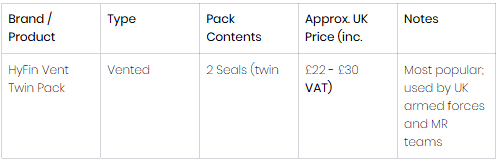
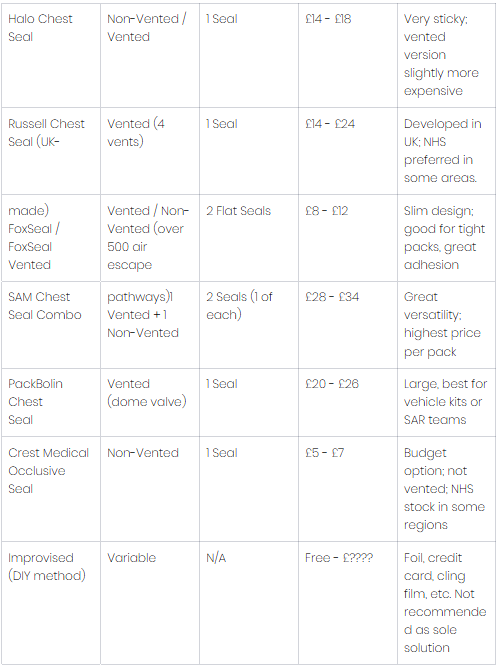
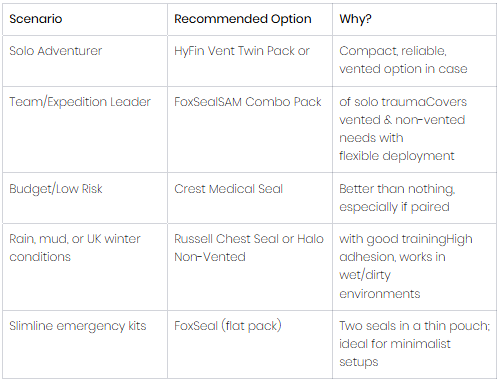
Best Value for Outdoor Use? So, Should You Carry One?
If you’re mountain biking in the Lakes, trekking across Dartmoor, or taking an axe into the Scottish woods, then yes, absolutely. Chest seals are lightweight, pack flat, and can save a life. Pair them with solid training and the ability to recognise chest injuries, and they become a critical component in your trauma care setup.
But don’t be tempted to just throw one in the bag without understanding how and when to use it. Get trained, practise with them (on mannequins or moulage), and consider carrying a vented and non-vented combo if space allows.
INSERT TABLE HERE
Advice
Don’t skimp on this item, chest seals are a “low frequency, high consequence” tool.
Buy from reputable suppliers (e.g. MedTree, Trauma Med Solutions, MERE, LifeSystems,TacMed).
If you’re restocking rescue team kits or expedition packs, consider buying in bulk for discounts.
Final Thoughts
Chest seals might sound like something for battlefields or ambulances, but for those of us who adventure far from the nearest defibrillator or A&E, they represent smart, modern preparedness.
So whether you’re heading up a winter gully or leading an expedition beyond the path, don’t just pack a chest seal, know how and when to use it. Where rescue may be delayed and re- assessment is key. For outdoor enthusiasts, it’s another reminder that equipment is only as good as the skill and judgment behind it. That’s what truly puts you beyond the basics.