
Don’t Bleed: Why Haemostats Deserve a Spot in Your Personal Kit - Choosing the Right Tool to Stop the Bleed
Beyond The Basics: Selecting the Right Medical Kit For Your Outdoor Adventures
Let’s be honest, if you’re heading into the hills with nothing more than a few plasters and a half squashed antiseptic wipe, you’re not really “prepared,” you’re just optimistic. And when it comes to outdoor injuries, optimism doesn’t stop bleeding.
Haemostats do.
If you spend any time climbing, hiking, paddling, base jumping, or just faffing about in places with your dog or family, it’s time to get serious about what’s in your first aid kit, and that means haemostatic agents.
There are certain things you don’t leave behind when heading into the wild, snacks, your sense of direction, spare socks. Add one more to the medical list, a decent haemostatic dressing.
So, let’s unpack what haemostats are, why they’re magic, and why not having them makes your med kit about as useful as a chocolate compass.
What Are Haemostats?
Haemostatic agents are materials impregnated with special substances that help your blood clot faster and better than it can do on its own when you are injured. They’re designed to stop catastrophic bleeding, the kind where your sock fills up with blood in seconds, not the kind you fix with a blue plaster and a cuddle.
Outdoor adventures often involve sharp rocks, tools, skis, paddles, ropes, and a good dose of bad luck. Accidents can happen that leave someone leaking in a way plasters can’t politely manage.
Typically, they come in two forms:
Gauze: Stuff it deep into a wound at the point of leaking (yes, deep).
Sponges or powders: Less common these days but still out there.
The most common active ingredients?
Kaolin (used in QuikClot Combat Gauze) – helps your body’s natural clotting process.
Chitosan (used in Celox or ChitoGauze) – creates an artificial clot barrier, even if your blood’s being awkward.
Rather than just soaking up blood like a sponge, a haemostat actively helps the blood clot faster, encouraging your body to plug the leak more effectively. It’s a brilliant bit of kit that plays well with others, it works alongside pressure, bandages, and other equipment rather than trying to steal the spotlight.
Why Should You Care?
Because bleeding out from an injury is shockingly quick. We’re talking minutes. Not hours. And if you’re two hours from the trailhead or halfway up a crag, it’s game over unless you’ve got something that can plug the leak.
Tourniquets stop the flow, but not every bleed is tourniquet eligible. Think groin wounds, neck wounds, junctional bleeds, that’s where haemostats shine. They’re compact, proven, and fast acting.
Why Outdoor Enthusiasts Should Especially Bother
You know the type:
“I don’t need a full med kit, I’m just going bouldering.”
“We’ll be fine, it’s a day hike.”
“We’ve got phone signal.”
Wrong, wrong, and guess what? Wrong again.
Nature is spectacularly good at trying to maim, puncture, and lacerate you when you least expect it:
Falls onto jagged rock? Hello femoral bleed.
Paddle vs propeller vs riverbed? Bloodbath.
Tree branch vs thigh? Arterial roulette.
In most outdoor emergencies, your bandwidth is fried, your fingers are cold, and you’re not thinking clearly. That’s when you need gear that works fast, and that doesn’t rely on good luck or fine motor skills.
Why Haemostats Belong in Your Kit
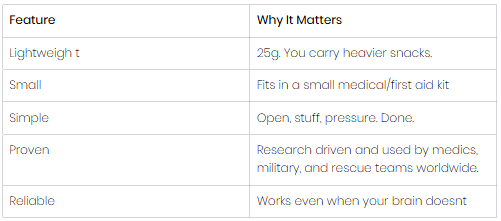
Haemostats aren’t luxury items. They’re not like that titanium spork you bought “just in case.” These are mission critical bits of kit and they tick all the right boxes:
Having haemostatic gauze in your kit means:
You can deal with deeper wounds where pressure alone might not be enough or is difficult.
You’ve got a way to control junctional bleeds (think groin, armpit, or neck, where a tourniquet isn’t ideal).
It’s compact and light, fits in your chest pouch or side pocket next to your Kendal Mint Cake.
It doesn’t require advanced skills, pack the wound firmly, hold pressure for a few minutes, and you’re already winning.
But don’t just pack one and forget it. Know how to use it. Stuff it into a training dummy (or a left over pork leg if you’re feeling rustic) and practise when you’re not covered in sweat and adrenaline.
Worth noting though, one may just be enough for one serious wound. If you’re building a group kit, doing something risky or leading trips, carrying multiple might be sensible. Remember to always assess the risk, environment, distance/time from further support and your population at risk.
Cost vs Catastrophe
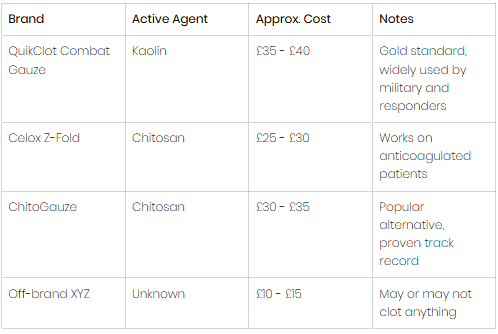
Good haemostatic gauze will set you back about £25–£40. More expensive than a pack of blister plasters but cheaper than a helicopter ride and a funeral? Absolutely.
If it’s under £15 and claims to be “haemostatic,” you’d better check it’s not made of wishful thinking and sugar dust.
What Makes a Good Haemostat?
Not all haemostats are created equal. Here’s what separates the kit you can rely on from the ones best left in the bargain bin:
The Good Stuff
CE marked and research proven - Look for brands tested in real clinical or tactical settings.
Kaolin based (like QuikClot Combat Gauze) – This promotes the body’s natural clotting cascade.
Chitosan based (like Celox or ChitoGauze) – Bonds directly to blood cells to form a clot, even if the patient’s on blood thinners.
Z-fold or flat packed/rolled – Easier to pack into wounds quickly and evenly.
Durable packaging – Won’t tear or burst in your rucksack.
These are the items seen in military med kits, mountain rescue teams, and among medics who’ve learned the hard way what actually works. Brands like Celox and QuikClot consistently come out on top, not because of shiny advertising, but because they’ve been used in real scenarios and they’ve done the job.
The Not So Good Stuff
Don’t rely on a haemostat instead of a tourniquet. They do different jobs.
Off brand or untested gauze. If you’ve never heard of it and it costs £4.99 on an auction site, it’s probably not the one. Don’t buy cheap knock offs. Counterfeit haemostats are sadly common.
Powders or granules in loose form were common years ago, but they’re messier and can be harder to apply effectively and safely.
Single layer dressings with no folding are harder to pack properly into deeper wounds.
Expired stock or repackaged gear past the shelf life may underperform. Buy from reliable retailers. This isn’t the time for mystery eBay parcels.
Good haemostats don’t just contain bleeding, they give you time and help you fight the lethal triad. And time is a fine thing to have when you’re deep in the fells or scrambling up something steep.
A Few Tips on Usage
Haemostats work best when packed deep into the wound. Don’t just lay it on top like a sad tissue.
Hold direct pressure on the wound for The recomended few minutes (Refer to manufacturer). This is key.
Combine with a pressure bandage to hold it all in place.
Practice helps. If you’ve never shoved a gauze roll into a synthetic wound, it’s worth trying. It’s not delicate, it’s deliberate.
Where It Lives in the Kit
Don’t bury it under your socks. A haemostat should be part of your bleed control core, alongside:
A tourniquet
A pressure dressing (Israeli or Olaes style)
Nitrile gloves
Trauma shears
It tucks nicely into a flat pouch or vacuum pack.
The Numbers Bit (Quick and Painless)
Final Word: You Don’t Have to Be a Medic
Be the reason someone walks out instead of being carried out.
You don’t need a stethoscope or a trauma surgeon badge to carry a haemostat.
You just need to have packed it, a brain, a bit of common sense, and a willingness to learn how to use it.
Whether you’re walking the dog in the woods or trekking across the Highlands, packing a haemostat says you’re someone who’s thought about the worst and decided to be ready for it, with no drama, just kit that works.
Bleeds happen, you’ve got a limited window to act. At that point, the fact you packed a trail bar and biodegradable soap isn’t going to help.
You’ve got your tourniquet, and your haemostat, tucked in your medical pouch like a pocket sized miracle.
Because when the blood hits the base layer, and the pressure’s on, you won’t be scrambling. You’ll be stuffing, pressing, saving a life.
Now go out, climb things, paddle wild rivers, and eat too many campfire marshmallows. Your kit’s got your back, and your bleeding femoral artery, if it comes to that.