
Tourniquets: No Longer A Tool Just For Military Medics – Choosing the Right Tool to Stop the Bleed
When it comes to medical care and first aid, controlling bleeding is one of the most critical skills and capabilities you can have, in every and any environment. Trauma and bleed control kits are no longer just for military medics or emergency responders, they are becoming essential for outdoor enthusiasts, families, commuters, and everyday carry.
It’s essential to understand what to include, what brands to trust, and unbelievably, due to our current geopolitical climate, how to spot a fake. With an emergency tourniquet, how you decide to balance packing size, price and functionality can make all the difference in an emergency.
Why Bleed Control is Critical
Uncontrolled bleeding is a leading cause of preventable death in trauma. Even minor injuries can escalate quickly if blood loss is not managed promptly, along with other factors. Whether you’re dealing with a hiking accident, horse riding incident, driving up to a roadside emergency, or an unexpected injury at home, having effective bleed control tools at hand can save lives. A trauma kit with proper bleed control equipment allows you to:
Apply pressure to control bleeding
Use tourniquets to control severe limb haemorrhage
Pack wounds with haemostatic agents (dressings that promote clotting, don’t worry, stay tuned for next article to explore these).
One of the most effective ways to prevent it is with a tourniquet. But not all tourniquets are created equal. Some save lives. Others simply fail.
This article breaks down the types of tourniquets, why some outperform others, what makes a good tourniquet for personal vs group use, and how factors like cost, bulk, and ease of application can make or break your decision, and possibly someone’s life.
What Is a Tourniquet?
A tourniquet is a device that applies focused pressure around a limb to stop blood flow to a traumatic wound. They’re typically used on arms and legs where direct pressure alone won’t control bleeding or you need to utilise precious recourses for other tasks. For example, a wounds after a penetrating injury, blast trauma from a cooking gas bottle overheating, vehicle incident, fall or deep laceration. Some newer types have been designed for junctional use on groins and armpits, but we are focusing in this article on limb application.
Tourniquets are not a last resort, modern pre-hospital research and military data confirm that timely application saves lives without always causing limb loss, especially in the pre-hospital phase.
Types of Tourniquets
1. Commercial (Purpose-Built) Tourniquets
Made to strict specifications, widely studied/researched, and used for public assess bleed kits, The Military, emergency medics, and rescue teams.
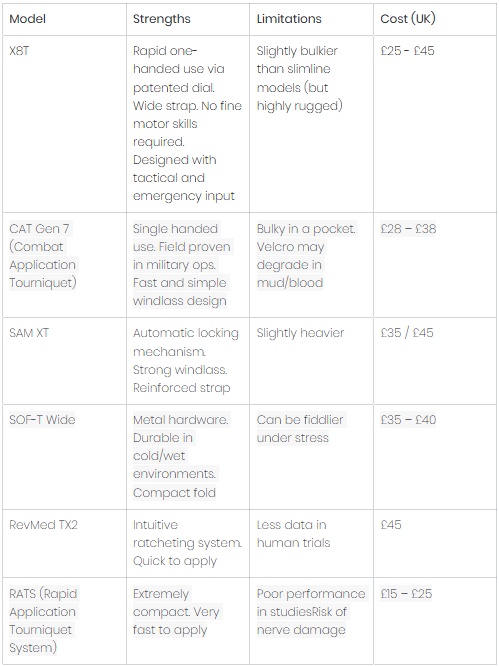
Best Options (Field-Proven)
Here’s a breakdown of some of the top commercial tourniquets:
2. Improvised Tourniquets
These are made from available items, belts, scarves, rope, etc.
If done well, better than nothing.
Often fail to apply enough pressure.
Can cause damage (nerve, tissue, vein).
Require skill, and practice to apply effectively.
Can be more painful that commercial tourniquets.
Acceptable only as a last/only resort.
Improvised kits that include purpose made windlass straps or pressure devices can offer better performance, but they’re rarely equal to commercial devices.
Tourniquet Application: On Yourself vs Others
A critical factor when choosing a tourniquet, that is often not spoken about in training or mentioned in product information is the difference in types of tourniquet when self applying or applying to another person. Not all models are equally usable one-handed, especially in high-stress, cold, or wet environments.
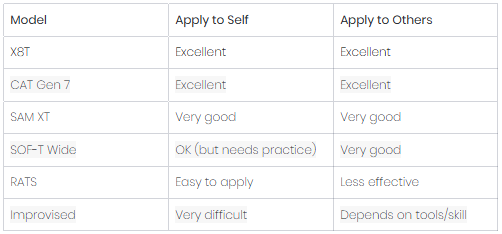
Models like X8T, CAT (Combat Application Tourniquet) and SAM XT are designed for single‑handed use, making them easier to apply under stress. Some tourniquets may require two hands or complex threading, making them impractical for self‑care. X8T and SOF‑T, however, are easier to apply to somebody else under stress and environmental challenges.
Remember to always consider the PPE (personal protective equipment) and clothing you will be wearing during your adventure and not what you are wearing while packing. Will you be completing your activity in thick gloves/mittens or a dry suit? These factors also play a huge part in human factors and your own stress level and ability to function when an emergency occurs.
What kit is going to support you and your factors best, when trying to utilise it on myself or somebody else, at the peak of stress, in the most amount of PPE I could possibly be wearing, in the worst possible environment, weather and time of day?
Size, Bulk, and Carriage
Size and weight matter, especially on ultra light hikes, hill racing, climbs, or when building a compact personal trauma kit.
Pouch placement is key: outer pocket, belt-mounted, chest rig, or externally MOLLE’d on your med bag.
Don’t bury it or spit it between bags or vehicles, your tourniquet should be the most accessible item you carry.
Cost vs Quality
A legitimate, field-proven tourniquet costs between £30–£45. Anything dramatically cheaper may be:
A counterfeit (dangerous and widely sold online)
A poor imitation that looks real but fails under pressure
A training only version not meant for real world use
Research unknown brands or untested models, lives depend on the equipment doing what it’s supposed to do under extreme conditions.
Look for These Features
When selecting a commercial tourniquet:
Windlass (winding) or ratcheting mechanism with lock
Wide strap (≥3.8cm / 1.5”) to reduce tissue damage
One handed, intuitive use capability
Tested by TCCC / CoTCCC (Committee on Tactical Combat Casualty Care)
Decent time tag or label area
Training: The Best Tourniquet Is the One You Can Use Under Stress
You must practice with your chosen tourniquet, on yourself and on others. Practice in:
Gloves
Low light
Bad weather
With your non-dominant hand
In full PPE
Refer back to our previous article referencing human factors and bandwidth for reasons to justify these. Tourniquet use is a high stress motor skill. Without rehearsal, it’s very easy to apply too loosely or too slowly.
Final Thoughts: One is None, Two is One
If space and budget allow, carry two tourniquets:
One for your dominant arm (in case it’s you injured)
One for treating others
Multiple Tourniquets for multiple injuries or casualties.
For expedition kits, paddling teams, rope crews or medics supporting high risk activities, this redundancy may be essential.
Summary
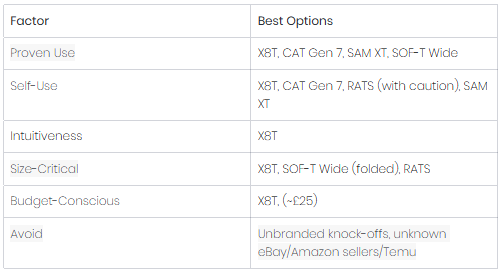
Recommendations for Outdoor Users
Solo adventurers / climbers: X8T, CAT Gen 7 or SOF-T Wide, mounted on belt or front pouch.
Group leaders: 2 - 4 x tourniquets, carried separately.
Water-based: X8T, SAM XT (good grip and materials), sealed in waterproof pouch.
Training: Get a training specific version or spares of the real version to rehearse with and keep the real one sealed.