
Through The Windscreen: Why Remote Vehicle Incident Management & Extrication Training Is Essential for Teams in Extreme Environments
Organisations and individuals that work in remote and extreme environments face risks far beyond what most urban responders prepare for.
Whether you’re running a humanitarian mission in South Sudan, maintaining critical infrastructure in Arctic territories, operating security logistics in mountainous conflict zones or driving through the hills of Wales, road traffic incidents (RTI) remain one of the highest risk to teams and individuals.
Why not call them road traffic collisions? Because this narrows the risk down to collision based events and doesnt take into account other vehicle related situations that we can train to avoid or handle more appropriately.
In these environments, the absence of timely emergency services means your team is the first, and possibly only, responder or support. That’s why investing in remote vehicle incident management and extrication training isn’t just about compliance or health and safety box ticking. It’s about survival.
The Harsh Reality of Remote Road Traffic Collisions
RTIs are one of the most common causes of fatality and serious injury for personnel operating in remote environments. It has been for a long time, and continues to be the biggest risk for UK Military and one of the largest killers in the UK of young adults.
In these locations, the terrain is unpredictable, weather conditions can turn rapidly, and vehicles are often heavily loaded or poorly maintained due to supply limitations.
Common contributing factors include:
Long drive times and fatigue
Challenging terrain (e.g., unsealed roads, river crossings, mountainous switchbacks)
Poor visibility or navigation errors
Mechanical failures in older or overloaded vehicles
Other road users
Differing road rules or cultural differences
Vehicle threats
In a city, help is minutes away. In the field, it could be six hours or more before a helicopter or any form of medical evacuation arrives, if it can come at all.
That means your team needs to manage the entire incident lifecycle themselves:
Secure the scene
Stabilise the vehicle
Triage and treat casualties
Extricate safely using minimal tools
Coordinate evacuation
Transport to definitive care
Remote Vehicle Incident Management: A Mission-Critical Skill Set
At the heart of this capability is proper training, not just in first aid, but in remote-specific incident response and extrication. This includes:
1. Scene Safety and Dynamic Risk Assessment
Windscreen report, taking in the size up on the incident and maintainng bandwidth
Securing the scene from threats and environmental hazards (e.g. the general public, weather conditions, cliff edges, rivers, wild animals)
Knowing what’s available such as vehicle chocks, ropes, even terrain features to stabilise the area
Stabalising the vehicle using improvised techniques e.g. other vehicles, ratchet straps, vehicle relocation, deflating tires.
Establishing command and communication hierarchy, even if only among four teammates
2. Casualty Assessment and Clinical Prioritisation
Understanding casualties mechanism of injury vs. the reality of delayed evacuation
Medicaly trapped or mechanicaly trapped?
Identifying red flags: crush injuries, compromised airways, internal bleeding
Applying field trauma care (e.g. tourniquets, splints, airway management) while preparing for delayed extraction
Creating extrication plans around the injuries sustained
Stay put or transport to care?
3. Improvised, Low-Tech Extrication Techniques
Understanding vehicle systems, their locations and hazards to rescuers
Space creation using small tools such as socket sets, pry bars
Glass management using multi tools, knifes,, safety blankets, or window punches
Patient removal strategies that mimic the latest evidence-based guidance
Use of team lifting and spine-protection methods when no spine boards are available
Stabilising casualties using what’s available: sleeping pads, rigid bags, rope, vehicle parts
Modifying other vehicles in order to transport casualties to definitive care
The focus is on simplicity, effectivness, minimising further harm and creating a casualty focused plan.
ENTER: The EXIT Project – Applying Clinical Evidence to Extrication
This is where Professor Tim Nutbeam’s EXIT Project (Extrication In Trauma) plays a transformative role.
The EXIT Project, a UK-based research initiative, is revolutionising how extrication is approached—not just by firefighters with high-end tools, but for responders in the field with limited resources and a pressing need for justified, evidence-based decisions.
What Makes the EXIT Project Groundbreaking?
Clinical Data Over Dogma: EXIT challenges outdated extrication norms and instead uses empirical data on patient physiology, injury mechanisms, and outcomes.
Speed vs. Safety: Research from EXIT has shown that prolonged entrapment, often due to over-cautious “spinal protection” procedures, can lead to hypoxia, crush injuries, or unnecessary death. In contrast, rapid extrication, when clinically justified, often leads to better outcomes.
Minimal Handling: EXIT emphasises methods that reduce unnecessary patient movement—crucial when spinal or thoracic injuries are suspected.
Adaptable Protocols: Their findings are now being translated into field-applicable models that non-specialist responders can use—perfect for remote deployment contexts.
In essence, EXIT provides the medical and scientific foundation to support what field-based teams already know: in many situations, waiting for a ‘perfect’ extrication is worse than doing a rapid, imperfect one if done correctly.
Training Recommendations for Field-Based Organisations
1. Embed Remote Incident Training into Core Preparedness
Every team member—not just the driver or medic—should understand:
Scene control
Basic extrication
Use of recovery and rescue tools
Patient triage and protection
Tactical communication under stress
2. Simulate Realistic Vehicle Incidents
Don’t teach in a car park. Simulate rollovers, side impacts, and entrapment in rough terrain. Use your own vehicles or write-off models. Practise under time pressure with basic gear.
3. Teach Extrication as a Medical Skill
Field medics and first responders need to see extrication as part of clinical care. It’s not enough to treat the injury—you must also enable safe rescue without worsening it.
4. Apply EXIT Principles to Field Protocols
Train your teams to:
Know when rapid extrication is justified
Prioritise airway, breathing, and circulation over rigid spinal immobilisation
Make justified decisions in line with best evidence—not just perceived protocol
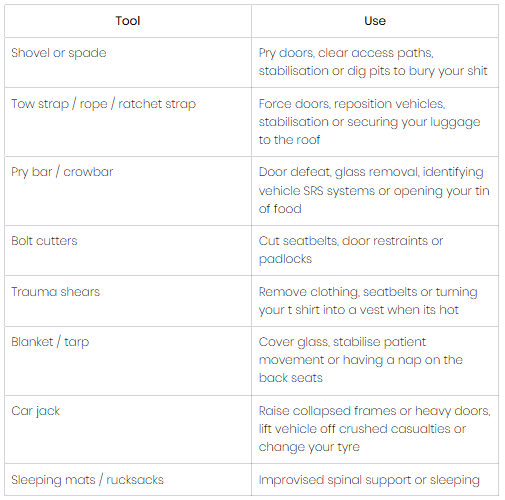
Tools You Probably Already Have — and How to Use Them for Rescue
You don’t need the “jaws of life” to save a teammate. Here’s a list of common field tools that can double as extrication aids:
Conclusion: Preparedness is the Real Rescue Tool
The best rescue in a remote vehicle collision isn’t a helicopter or a fire truck. It’s a trained teammate who knows how to take control, triage effectively, and act decisively with whatever tools are available.
By integrating remote incident management training and drawing on clinically validated resources like the EXIT Project, organisations can turn potential tragedies into survivable events.
Whether you’re operating in the jungle, tundra, savannah, or desert, your greatest asset is your team’s ability to respond safely and intelligently.
Want to go further?
To bring remote vehicle incident and extrication training to your organisation, consider:
Booking onto our bespoke R-VIM (Remote Vehicle incident Management) course or contact us to create a bespoke training package for you and your team
Using simulated vehicle crash drills as part of pre-deployment exercises
Engaging with the latest findings from the EXIT Project to update your SOPs
Because in the field, you are the rescue team.
Whats next?
In my next post I will be breaking down each of these aspects and focusing on each one in more detail. I will begin with exploring the 'Windscreen Report'.